
A mobile app, more commonly known as a mobile app or simply an app, is software for smartphones, tablets and other mobile devices. They are generally distributed through dedicated platforms such as the Apple App Store, Google Play, Windows Phone Store and BlackBerry App World.
The use of mobile phones has become an integral part of our daily lives. The figures for mobile phone use in Estonia alone are impressive. According to a survey by Statistics Estonia, 1.05 million people in Estonia use their mobile phones to access the internet. And as many as 97% of young people aged 16-24 in Estonia only use their mobile phones to go online.
A thought-provoking result! Add to this the fact that two out of three people worldwide already have a phone in their pocket, and it’s no wonder that mobile technologies and the mobile internet represent a rapidly growing market today. E-commerce is no exception, which means that the opportunities for businesses to benefit from mobile applications are huge.
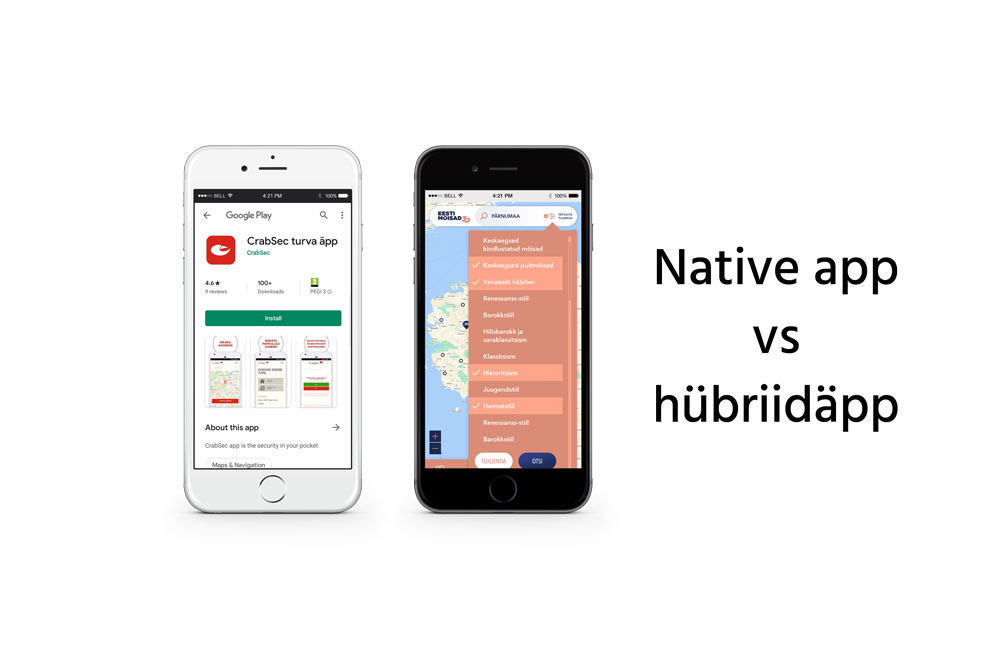
There are two types of mobile apps – native apps and hybrid apps.
Native apps are custom apps for the platform they run on, such as iOS or Android, and have the advantage of speed and ease of use. These mobile apps also allow full use of the mobile hardware: camera, gyroscope, GPS and other solutions.
Native apps must be written for each platform and essentially cannot share code, making native apps more expensive than hybrid apps. However, the standalone mobile app has several advantages over the hybrid version. For example, the ability to upload it to the Google Play Store and the App Store will also help the app to spread better and ensure that users save it to their phone.
A hybrid app is essentially a website, so it’s not as fast as a native app, but it has the advantage of not having to write a separate app for each platform. This makes it quicker to create and maintain and therefore cheaper. The main drawbacks of a hybrid app are related to user experience (UX). As the app needs to work on multiple mobile platforms, intuitiveness is compromised and there is a mismatch between design, features and functionality.
What advantage do mobile apps bring to your business?
VISION
Setting up an app gives your business more visibility. Mobile apps make full use of mobile phone hardware and various sensors. You can send push notifications to your customers and offer additional features such as GPS functionality, QR codes, podcasts. This means that your customers are sure to receive your messages, and you don’t have to worry about spam. You can also use the app to offer your customers a range of discounts and discounts to keep them engaged.


AVAILABILITY AND SPEED
As the amount of time spent online increases, so does the number of online purchases. For customers, the availability and speed of a product, information, service, anytime, anywhere is important. This is exactly what mobile apps offer, typically 1.5 times faster than mobile websites. The user experience is also much more enjoyable because, in addition to speed, mobile apps can also perform operations much more smoothly because they store their data directly on the user’s device and therefore work with the existing system on the smart device itself. Mobile websites, on the other hand, need to pull data from web servers, which can take anywhere from a few seconds to a few minutes, depending on network speed and packet size.
JUDEDEPÄÄS
All mobile apps offer instant access. They allow users to quickly consume their content and store vital data so they can access it offline. The ability to work offline is the most important difference between an app and a mobile website. While apps require an active internet connection for critical operations such as payments and notifications, they also provide users with basic content and functionality in offline mode. Also, some apps are able to run in the background of other apps, which increases accessibility and simultaneous consumption of multiple apps.
INNOVATIVITY
It’s another way to stand out – be innovative, be first. Creating a mobile app, after all, can open up a whole new way for a traditional business to serve its customers, and can also help you gain a competitive edge if your competitors haven’t already created an app. Unlike websites, which rely on the limitations of web browsers for functionality, mobile apps can be created to be very handy. A touch screen brings a variety of gestures such astap, doubletap,swipe orpan. These types of gestures increase user comfort, which in turn creates the potential for higher sales.

