
The growing popularity of smart devices has also opened up new opportunities for businesses to bring their products and services to consumers. While a website has become a hygiene necessity for every entrepreneur, like washing your hands – and it is difficult to reach your target audience without one – businesses are increasingly finding themselves thinking about mobile.
While the vast majority of us are familiar with mobile apps and use them on a daily basis, there are still many entrepreneurs who are not. As much as 90% of the initial product/business searches are done by Estonians on a mobile device. But should every company still have its own mobile app?
We’ll give you the lowdown on mobile apps – what they are, what you might need them for and how costly the investment can be. We’ll give you some ideas to think about before you make a decision, because is it really worth creating a mobile app just because everyone else has one?
What are mobile apps?
Mobile apps are software designed specifically for smartphones and tablets that require downloading to a smart device. Unlike traditional software that runs on desktops and laptops, mobile apps are optimised for smaller screens and touchscreen use.
Specificities of mobile apps
Mobile apps offer a wide range of features, from social media and entertainment to professional tools, providing users with convenient and fast access to the activities they want to do directly from their mobile devices.
Initially, mobile apps were primarily used to provide specific functions, such as email, calendar, contacts and weather. Apps were often device-specific and came with the device. The more popular smart devices became, the more people started to see mobile apps as an opportunity for a standalone business. Today, mobile apps have become commonplace on every smart device, providing entertainment, navigation assistance, mobile banking, online shopping and much more.
While on the web you can navigate between many different websites, a mobile app is focused on a single company, service or activity. This gives you the opportunity to interact directly with your customers, offer them concentrated activities and remove distractions. In a mobile app, the user can only do what the app owner has given them the opportunity to do. While the functionality is limited, it can nevertheless create an invaluable experience for the user.
What is the value of mobile apps?
Mobile apps provide consumers with fast and convenient access to different services and information directly on their smart devices. They enable businesses to increase their customer base and take the user experience and customer relationship to the next level.
Mobile apps are also important for marketing and branding strategies. Apps make it easier to engage with your customers, convey the essence of your brand and build a loyal customer base. In addition, they can increase work efficiency by providing users with tools that simplify and speed up day-to-day activities.
If the app is more than just a marketing channel, it also provides greater access to the functionality of a smart device, offering the possibility to combine the physical and virtual experience.

How a mobile app can help business growth and customer engagement
A mobile app can make a significant contribution to business growth and customer engagement. A well-designed app can help you keep your customers’ attention for longer.
Firstly, it allows businesses to offer a fast and convenient service to their customers, which increases customer satisfaction and loyalty. Customers’ attention is not distracted, and your information does not compete with anyone else’s in the app.
Secondly, apps allow the collection of valuable user behaviour data that can be analysed and used for targeted marketing activities. The better we understand our customers, the more effectively we can design their user experience.
In addition, mobile apps also support more personalised interaction with consumers. They enable the delivery of personalised offers and information that is relevant to the individual user. In this way, you can organise a variety of marketing activities involving only specific customer groups.
Successful mobile apps from around the world
As mentioned above, there are all kinds of mobile apps – some allow you to do just one specific activity, others just provide information, while others offer more features. Let’s take a closer look at what kind of mobile apps have been created…
- Social media platforms – most of us use social media apps on a daily basis. We communicate with our friends on Facebook Messenger, share snapshots of what we’re up to on Instagram and spend time watching videos on TikTok. The main purpose of social media platforms is to facilitate communication and the sharing of life events.
- E-commerce mobile apps – maybe you’ve booked a hotel through Booking? Or bought shoes from Zalando? Or ordered food via Walt? Many companies offering products and services have created a mobile app for their own goods, making it easy to discover and purchase products. They often also allow you to save favourites, manage orders and keep an eye on offers. Some even offer additional discounts to app users.
- Educational mobile apps – Mobile apps with an educational purpose are becoming increasingly popular. Not only do they collect valuable information, but they also help to implement effective learning methods. Duolingo, for example, is a popular language learning app, and MindValley offers a wide range of online tutorials.
- Health/lifestyle apps – many smart devices come with a health app built-in, plus of course you can download apps to help you track your exercise and diet, offer exercise plans and give advice on mental health.
- Financial and productivity apps – while a large proportion of Estonians are used to using mobile banking, there are also a range of apps that can help you manage your budget and investments.
- Games and entertainment – who among us doesn’t know popular games like Angry Birds. The nostalgic Nokia worm game can be seen as the forerunner of such apps. Already, phones with a button had ‘different apps’.
- Navigation apps – I don’t think any of us can imagine having to unfold a big map when we travel today. Navigation apps like Waze and Google Maps have become part of our everyday lives.
There are certainly many more apps out there that are more difficult to categorise. What is clear is that there are few who do not carry a smartphone with them on a daily basis and there are customers for apps.
Before subscribing to a mobile app…
Before ordering a mobile app, it’s important to think about some key aspects to ensure the outcome meets expectations.
Firstly, you need a clear vision and objectives of what you want to achieve with the app. Ask yourself – what are the benefits for my users and why should they adopt the app?
Secondly, you need to define the target audience for your app, i.e. who your users are.
Third, you need to choose the right platform (iOS, Android or both) and development method (native, hybrid or web).
It’s also important to consider the cost and timeframe of development and to find a reliable development partner who can meet the technical requirements and provide a quality service. Involve project experts to help identify potential risks and optimise the development process.
Costs of mobile app development
You’re probably wondering how much it costs to develop a mobile app. Unfortunately, answering this is like predicting from a crystal ball, because there is simply no single answer. A lot depends on your goals and ambition.
The price of a mobile app is usually made up of two components – the volume of development and the hourly rate. In more complex cases, a separate designer, tester, SEO specialist, or other specific employee who plays a specific role in the project and whose pricing may differ from the developer’s may be added to the equation.
As a mobile app is a tailor-made job, every wish affects the price. The simpler the app and the less functionality, the cheaper it is. App prices start from a few thousand euros and there is no upper limit. For example, game development is more time-consuming than the average and it is no wonder that hundreds of thousands of euros, if not millions, are spent on developing a good game.
In addition to functionality and design complexity, technical decisions also come into play when it comes to price. For example, the cost will depend on whether the app is native for different platforms or a hybrid solution is chosen. A competent developer will be able to provide an adequate quote by asking the right questions.
Native app versus hybrid app
There are two main approaches to mobile app development: native apps and hybrid apps.
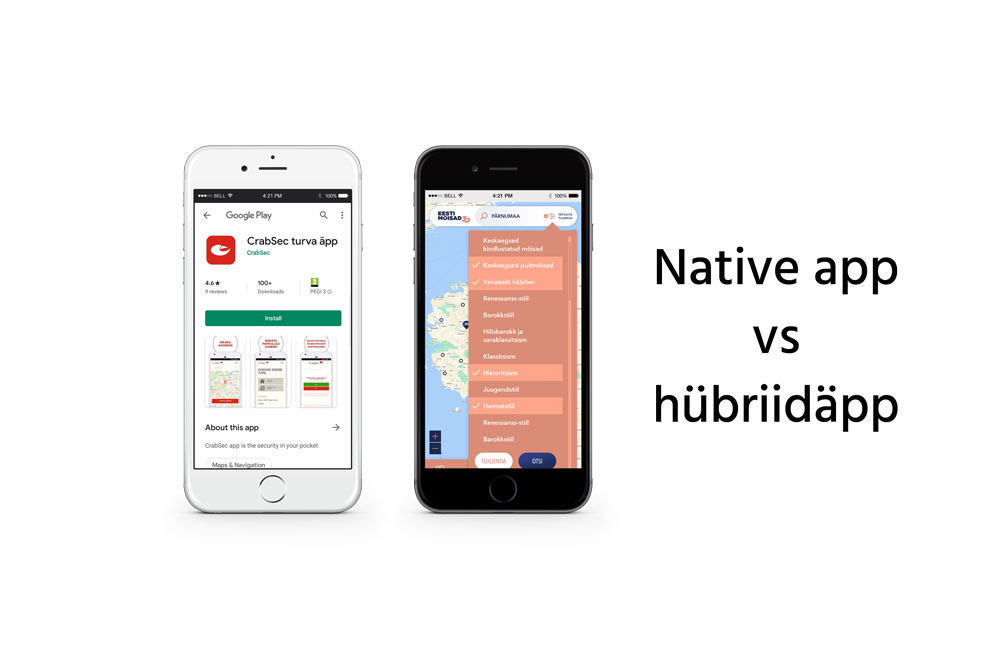
Native apps are developed specifically for specific platforms, such as iOS or Android, exploiting the hardware potential of the device to provide a smoother user experience. Hybrid apps, on the other hand, create a common platform using web technologies, which allows them to be developed and launched more quickly and cheaply on multiple platforms, but may limit access to certain device-specific features.
The choice will depend on budget, timeframe and the scope of the desired application functionality.
Don’t step into a bucket
As with any software development process, there are risks in developing a mobile app. If you anticipate shortcomings early in the development process, you can be sure that the result will be significantly closer to expectations and fewer rounds of improvements.
What should you think about?
User experience is vital
Yes, from an app perspective, user experience is really a matter of life or death. If it’s not convenient to use, it’s not useful because customers will simply delete it from their device. While visually an app can be wonderful, it won’t be a success if the navigation is complicated and what you need is hard to find.
Measure 9 times, cut 1 time
Such a proverb can be safely applied to describe mobile app testing. Test, test and test again. If possible, test on complete strangers who will give you honest feedback. The fewer bugs in a live app, the better the first impression you leave with users.
Costs vs revenues
Often no thought is given to how the application will generate revenue. Even if you don’t sell products or services through the app, there are other ways to generate revenue from the app. For example, it is possible to sell advertising in your app, sell access to your app or offer partially paid content. Even in the case of a marketing tool, it is still possible to provide additional content to users through themed content marketing articles or blog posts, making money from the app.
Care is the basis for sustainability
Just as your website needs maintenance, so does your app. Keep your app relevant and secure, analyse its technical health and make improvements where necessary. This way, you’ll maintain credibility in the eyes of your users and protect yourself from data leaks. By maintaining your app on a monthly basis, the cost of maintenance will certainly be lower than the resource spent on fixing problems later.
Would like cheaper
Clearly, a mobile app is a significant investment, as a quality app costs more than the annual marketing budget of many companies. While tools for creating simpler apps can be found online, today they are still rather limited in their capabilities and the result is rather amateurish.
With a limited budget, we recommend that you invest everything you can in quality web development. That way, you’ll still be found online by your customers, and a quality website is more of a benefit than a half-baked website and a poor app.
The mobile app market is still in its infancy, and as the capabilities of our smart devices continue to evolve, new opportunities to create apps will emerge. Whether it’s the desire to start a new business with an app or to promote an existing one. As the market evolves, so will the number of developers, which will help to make what currently qualifies as an investment more affordable and accessible.
If you don’t have a very strong business idea for a mobile app, or too big a marketing budget to develop a new promotional channel, we recommend postponing app development for the moment. It will certainly be as easy to create apps in the future as it is to create websites today, but for the time being, choosing an app has to be a strategic business decision.
