
There’s no denying that business has largely moved online. If you’re not online, you don’t exist. The web is where people go to find entertainment, to learn, to do much of their shopping and to communicate with their loved ones. The virtual world is no longer the domain of young consumers; even our grandparents are used to reading the news on Delphi and booking doctors’ appointments through the digital registry. Even among the elderly, more than half are internet users.
If consumers are used to being online on a daily basis, service providers need to be there too. Your website is your digital business card, whatever products or services you offer – whether or not your product is just information. Because of this, most business owners are also website owners.
What should a website owner know in order to outsource effectively, be closer to customers and offer them value? With the Web Systems team, we have been building websites for over 17 years. We’ve put together the ABC’s of web development that every knowledgeable website owner should be familiar with to better understand us.
Web developer – a mysterious creature
No, a web developer is not actually a complicated creature who lines up symbols at a computer and conjures up a website. In fact, we all speak the same language as you, we’ve just mastered the language of computers.
You might think that a web developer is a multi-talented person who designs, programs and even does marketing, but there are different types of people in our midst who actually specialise in different components of web development. Most of the time, our clients don’t know how many people go into creating a quality website. So who is on our team?

- Front-end developer – A developer specialising in front-enddevelopment is responsible for bringing a design to life. He or she ensures that the entire visible part of the website is in working order and matches the design created by the web designer. The front-end developer is responsible for making sure the design works – that when buttons are clicked, functions are triggered, data flows correctly and content is visible to users.
- Back-end developer – we don’t see the back-end developer’s work on the website, but we feel it with every click. They make sure that the web components and databases work, that the necessary interfaces are made and that the front-end is properly supported. Back-end development is a technical task that the website owner rarely encounters, even when creating a website for a platform.
- Full stack developer – has a bit of front-end developer but also a bit of back-end specialist. His versatility lies in his ability to connect the processes in the background with the facade that is displayed to the consumer. He understands the whole web development process from start to finish and sees the website as a whole.
- JavaScript developer – JavaScript is one of the most widely used programming languages, which is why every digital agency needs such a specialist. Thanks to him, it is possible to create complex websites that require a detailed understanding of programming and the creativity to create something special. It is the special solutions that are created under his watchful eye.
- Web designer – to help visualise the client’s ideas. Sets out what the consumer’s first impression should be when they arrive at the website. Makes the brand recognisable and highlights what’s most important. Their work forms the basis for the developers who bring the design to life, giving the website functionality and ensuring that the design becomes a website that consumers can see.
- UX/UI designer – The internet has become a vast collection of information and there are countless websites for consumers to visit. A UX/UI designer will make sure that your website is attractive and functional for users.
- System administrator – a digital specialist who deals with web servers and databases. Most website owners don’t need the help of a system administrator as they can get enough support from their web hosting company, but the larger the business and the more complex the system, the more likely it is that it makes sense to outsource the management of servers and databases.
- The tester – we all make mistakes or just don’t notice every little detail when we’re in the middle of a workflow. That’s why testing is essential in any website development. A tester reviews every web page in detail, checks the logic of actions and tries to prevent inconvenient situations for consumers. He or she checks that everything is working as it should.
- SEO Specialist (or even Marketing Specialist) – website optimisation is essential to reach customers in a competitive market. SEO processes and systems have evolved rapidly and an SEO specialist can help you make the most of them. As SEO also involves a range of marketing activities, there is often a dedicated specialist in a digital agency who thinks beyond the specific website.
Why are we so curious?
A web developer must be curious by nature. We can’t see into the client’s head, and the only way to get clarity is to ask a lot of questions. At times, the questions may seem strange to the client, but the better we know our client, and in turn their clients, the better advice we can give.
Behind the creation of any website is a trusting relationship between web developers and the client. Don’t worry that we’re asking questions to spy on you – we stick to our guns and the client relationship is always confidential.

Web development guided by customer responses
We can only meet the client’s wishes if we truly understand them. It’s not our job to judge how big your business is, what you offer your customers or who your customers are. But we do want to help you run your business successfully.
Questions about colours, fonts and images help us to design the visuals that match your brand. Understanding the consumer is again essential to designing an end-to-end user experience. Analysing your workflows can help provide different system integrations that simplify and automate your work.
Every question has a reason. Every answer leads to a better result. And we do our best to make sure you get the questions right and we understand the answers.
How is web development done?
In fact, the website owner does not need to know in detail how the website will be built. Once the input is clear and the goals are understood, it is up to the web developer to deliver the website to the client. But as a curious creature, we still want to know how things come about, so let’s give a little background on how we make the ideas in someone’s head a reality.
Brainstorming
Creating a website starts with brainstorming. Our job is to understand the client, their needs and their desires. After all, the goal is not to create just another website, but an effective sales tool. We analyse the products/services on offer, sales processes, customer behaviour and much more, so that the team can get started on the website.
Website
Based on the set objectives and input, the web designer will start to produce a sample visual. Depending on the needs, a UX/UI designer will also be involved. In addition to designing a beautiful website, a logical structure will be ensured. The client will then receive a sample of the homepage – this is exactly what the homepage will look like when the developers add functionality. The web designer will make a sample of all the interfaces to give the client a better overview and enough input for their team for the next steps.
Web development
Once the design is approved by the client, the work moves to the developers. Depending on the complexity of the work, the website may be developed by one or more web developers. They bring the design to life, add functionality and make the website usable.
Testing
Once the developers have done their best, it’s time for the tester to start looking for bugs. It’s our responsibility to make sure that all the features work, the design matches the samples, the page is secure and the user experience is as expected. During the testing process, we will identify bottlenecks, fix bugs and, if necessary, make some further developments to ensure that all functionality is guaranteed.
Publication, marketing and maintenance
At this point, the page is ready for publication, but a good website needs more work. A knowledgeable website owner will also invest in optimising their website, or SEO, to make it more attractive to search engines and easier for consumers to find.
Because everything on the web is constantly changing, your website will continue to need maintenance and support. Upgrades need to be made, both technically and in terms of content, so that your website doesn’t become stale. A constantly updated site will also give your customers more reason to come back.
Can I still order?
A website owner certainly does not need to have a technical education to order a quality website. In fact, it is enough for the business owner to know what he does, who his customers are and what he wants to achieve with his website. The complicated terms like CSS, HTML and API can be left to us.
It’s our job to translate your wishes into the right language, so that the website you envisioned in your mind’s eye is exactly what you want. Once you’ve set your wishes, the rest is up to us.
Changing trends and needs
In many ways, web development is about understanding and keeping up with change. Technical systems change and, more importantly, consumer expectations and habits change. A good website is constantly evolving to meet needs and be competitive.
Phone as a wise man in your pocket
Various international studies have found that 90% of business-related searches are carried out on a mobile device, and as much as 60% of e-shopping has moved to mobile. We have become used to the idea that all we need to do to find information is open Google and even vague search terms will get us results quickly.

Consequently, you also need to analyse whether your website is conducive to content consumption on a mobile device. A mobile view of a website requires scaling the website to make it visually beautiful and conveniently functional on a vertical screen. This also needs to take into account how convenient it is to consume content on a smaller screen. In some cases, it may even be worth considering developing a mobile app.
A world full of dangers
The virtual world is as full of dangers as the world around us. Traffic accidents don’t happen there, but theft and fraud do. It is the responsibility of every website owner to protect the information their customers share with them. At the same time, they must also protect their own data and virtual assets, so as not to miss out on hard work and effort.
A trustworthy website is also a secure website. Updated website components and the necessary certificates are the A&O of a secure site. Small elements such as the year of website updates and the GDPR policy, which is mandatory in Europe, add to the credibility of a website.
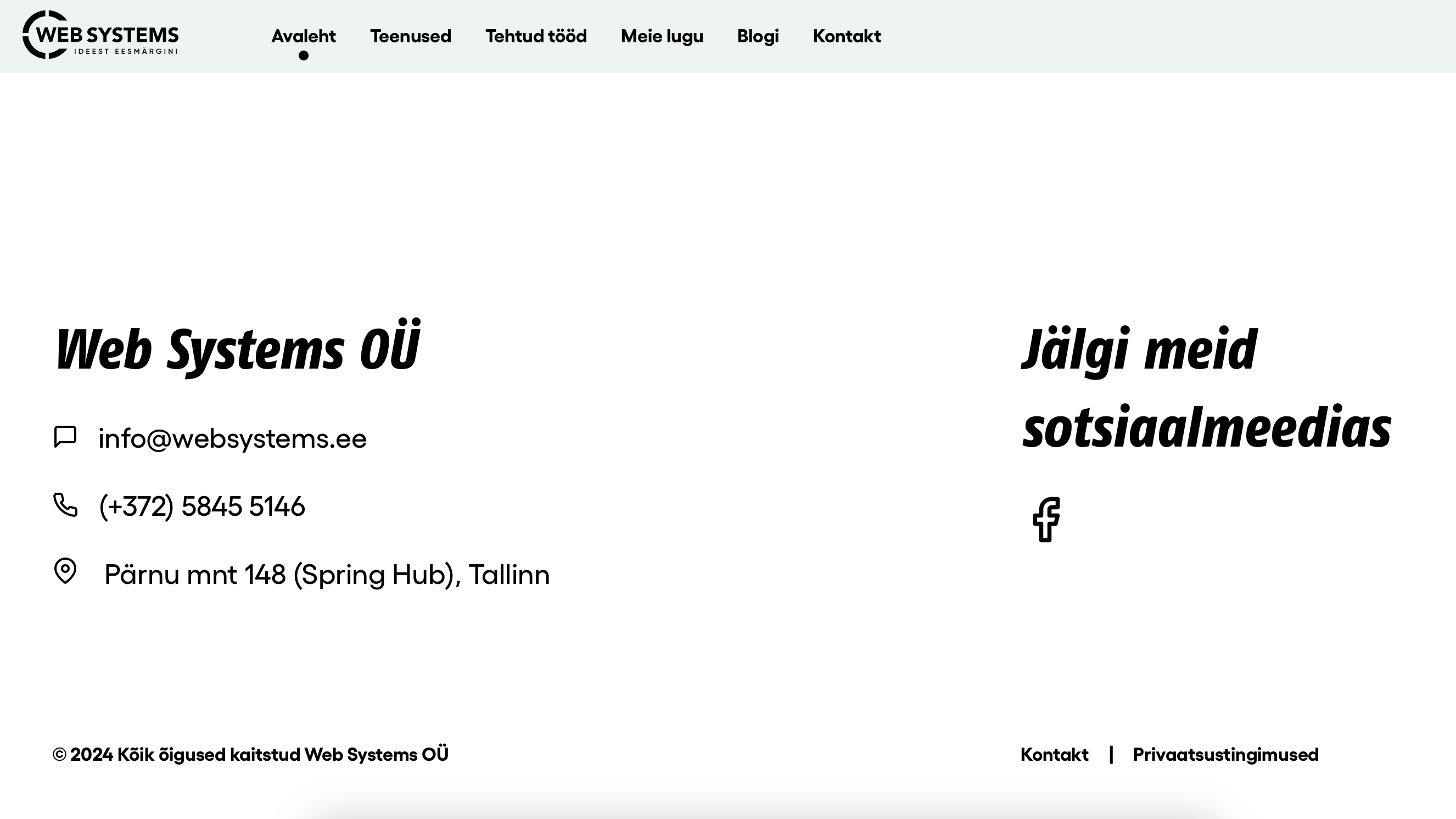
Even though we do not have an e-shop on our website, we still interact with our customers through our e-shop, which is why the Privacy Policy is also binding for us. Also, the year number at the foot of the page indicates that our page is up to date.
Time is money
On the web, pages that are fast for the user in all respects work better. The page loads quickly, the information can be found quickly and it offers the user a quick solution.
The website needs to be visually appealing, but still technically fast. Do not overload the page with unnecessary visuals or add print-quality images.
It is worth assessing the relevance of all content. It may seem that any additional information will always be useful, but you should make sure that it still has value. It is worth structuring the text, making it easy to distinguish, and ensuring that menus and headings are relevant to the content of the page. The links you include must be relevant and always work! If consumers cannot find information quickly and easily, they will simply leave the page.
This is why testing is also necessary to identify bottlenecks. The user experience of a website is critical, it is the way that customer interaction takes place, whether passive or active.
How do we consume content?
The more our lives move online, the more our consumption habits change. We rarely look for information in books, we read the news online rather than waiting for the evening news, and we often check product feedback online rather than asking the shopkeeper for advice. In an information overload, we need to effectively filter and instantly analyse endless information. All this affects how a smart entrepreneur should design his virtual business card.
It is still true that first impressions can shape the whole experience. The user decides in an instant whether to move on or move away from a website. The homepage is the basis for deciding whether the information I need can be found on the site, whether the company is trustworthy, whether the products are desirable and whether I can find what I want. Make sure your site’s homepage is trustworthy, eye-catching and easy to understand.
With so much information, we need to think about how we present it to users. Nobody will be attracted to read a long, unstructured and unvisualised text where finding information is like looking for a needle in a haystack. Use lists, illustrative pictures and videos, and graphs. Organised text is easier to read, and highlighted text is the first way to get the most important information. The younger generation in particular is used to consuming content visually. It is understandable when you have to spend days studying textbooks full of text. So there is no need to be afraid of images or videos, as long as they are relevant.
To sum up
We all come into contact with web development at some point – all of us consume the content we find on the web, and some of us have to create that content. As an informed outsourcer, you can ensure that your investment delivers results and that your web development bears fruit. While you don’t need to be a web developer to navigate this world, having a basic knowledge of the basics will make the process easier for all involved. With a trusted partner, however, web development can be a real pleasure!
